
We recently initiated a quarterly book club in the H+D office, and expect to make our thoughts on these books a regular feature of this publication. The inaugural selection was Cory Doctorow’s 2025, “Enshittification: Why Everything Suddenly Got Worse and What to Do About It”, which turned out to be a somewhat depressing first entry. Note, for those whose sensibilities are offended by the title, we censored the name in this edition’s table of contents but go on to use it liberally here—our apologies!
Doctorow coined the neologism “enshittification” in 2022 to describe the almost inevitable decay of online platforms, driven primarily by corporate greed. This downfall hit across the spectrum, from search (Google), social media (Facebook and Twitter), hardware (iPhone), software (Microsoft and Adobe), and ecommerce sites (Amazon). For regular consumers of these products, the conclusion that each one progressively worsened over time is not surprising, but the process and reasons behind the rot is frighteningly similar.
In the first days of widespread internet usage in the 1990s and early 2000s, many “netizens” believed that direct access to other users would remove or at least marginalize middlemen and gatekeepers. The hope was this democratization of access would allow a flourishing of ideas outside the mainstream channels like TV or publishing controlled by corporate interests. However, as platforms have come to dominate their respective markets, it is somehow these middlemen who are now more powerful than ever.
New platforms, like Google Search, began as sources of joy for users. Search used to be magical in its ability to return the right results, and that magic created so much trust that Google became the default, and basically only, search engine for the world (outside of China). But the magic didn’t last. Management took advantage of the lack of competition to prioritize ad revenue over search quality. Over time, ads went from the sidebar to the top, and sponsored results crowded out organic ones. This in turn forced users to spend more time on the platform, further raising ad revenue.
This was all part of a consistent playbook that Doctorow identifies. He lays out three phases. First, users flock to the magical new offering for connection, convenience, or uniqueness. The platform scales by running at a loss or very low margins, and the economic “surplus” goes to consumers. Second, having achieved scale with a critical mass of users, platform owners look to monetize it, often turning to advertising. This phase aims at pleasing the new clients (businesses) at the expense of the users, slowly grinding away the original magic feeling. The platform now becomes the place to be for both users and businesses: users benefit from not paying (e.g. for search), and businesses know where to go for all the “eyeballs” and consumer data. This creates a “network effect” that underpins the company’s moat—it is easier to monetize their middleman service once both sides are locked in.
Finally, phase three is where the enshittification really occurs. The platform uses its ever-expanding wealth to bury the competition by outspending them in R&D, booking exclusive deals, copying them, or simply buying them out. The lack of competition plus locked-in users and advertisers allows the firm to capture all of the surplus, i.e. revenue and margins, for itself at the expense of users and businesses, as seen with Google Search. Even if users want to switch, the lack of competition makes moving on difficult. Over the last 15 years, Google Search’s worldwide market share remained above 89% despite an estimated $100 billion spent by Microsoft over the last 20 years on its competing offer, Bing.
We have been picking on Google, but every supersized tech company has followed the same path. Despite spurts of anti-trust regulation and some pushback among employees, usually the true believers in their pre-enshittified products, efforts to curtail the trend have fallen flat. So if these platforms have devolved into such awful experiences, why do they still dominate the stock market?
And dominate they do—Apple, Amazon, Microsoft, Alphabet, and Meta make up over 23% of the S&P 500 index. Part of that is because what we have been describing are in effect monopoly-like companies capable of protecting robust earnings growth over many years. Notice the chart below and just how sticky use of these platforms has been. Even X has barely budged despite being universally lambasted for how terrible it became after its days known as Twitter.
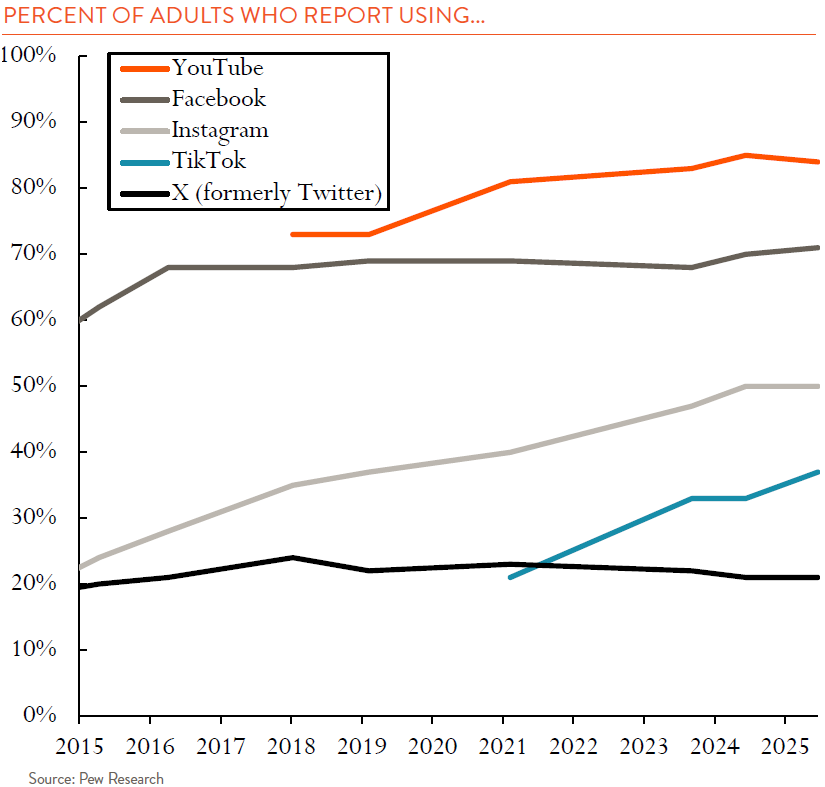
Is this a good thing or a bad thing from an investment standpoint? Clearly these companies have been among the best performers of the internet era, but it’s not clear that it will last. One takeaway from Doctorow is that there is a downside to platform decay owing to lack of competition. It can lead to misguided investment in poorly fitting markets, and dissatisfaction with the offerings themselves makes them targets for disruption. What the network effect giveth, it can taketh away if exodus reaches a tipping point. Meta may be an example of this, both in the billions of dollars wasted on the Metaverse flop and as younger users flock to TikTok and other social media platforms. Unfortunately, with Meta and others, any potential hit to financial performance from declining platforms is currently clouded by the booming AI trade, since most of them are involved in developing the underlying models or providing the infrastructure.
As we look around the tech world right now, we are on the lookout for lessons from the Enshittification playbook. Are AI platforms, for example, exhibiting some of the same characteristics that we have seen in the past? Use has been marked by magical feelings and the companies have used their massive cash infusions to attract users with free or subsidized subscriptions. However, now they are looking to incorporate ads, throttle free usage, and raise prices on subscriptions as the firms look to go public in the near future. Check, check, check. Time will tell, but this feels familiar.
Enshittification left us with a rather depressed, sinking feeling. While we are grateful for emerging with clearer eyes, perhaps next quarter we will look for something a little brighter.
