
Five decades ago, the average Chinese hoped for the ‘Three Bigs’: a bicycle, a wristwatch, and a manual sewing machine. After the ‘Reform and Opening Up’ policies were instituted by Deng Xiaopingin 1980, change occurred quickly. Over the past forty-five years, more people have been lifted out of poverty than has ever happened in any country in history.
The recent meeting between Xi Jinping and President Trump reflects these changes. The summit was a meeting of equals, something that would not have been the case back in 1980. The meeting was more a symbolic photo shoot than one producing meaningful results, but there will be other summits in the near future. Both countries need important things from the other.
The U.S. would like a full economic reset with China. It needs a commitment from China to buy more U.S. products, it wants assured access to China’s rare earths, critical for high-tech manufacturing, and it wants greater access to China’s domestic market. China, for its part, wants reduced tariffs in order to export more to the U.S. It also wants a signal from Trump that the U.S. supports China’s effort at reunification with Taiwan.
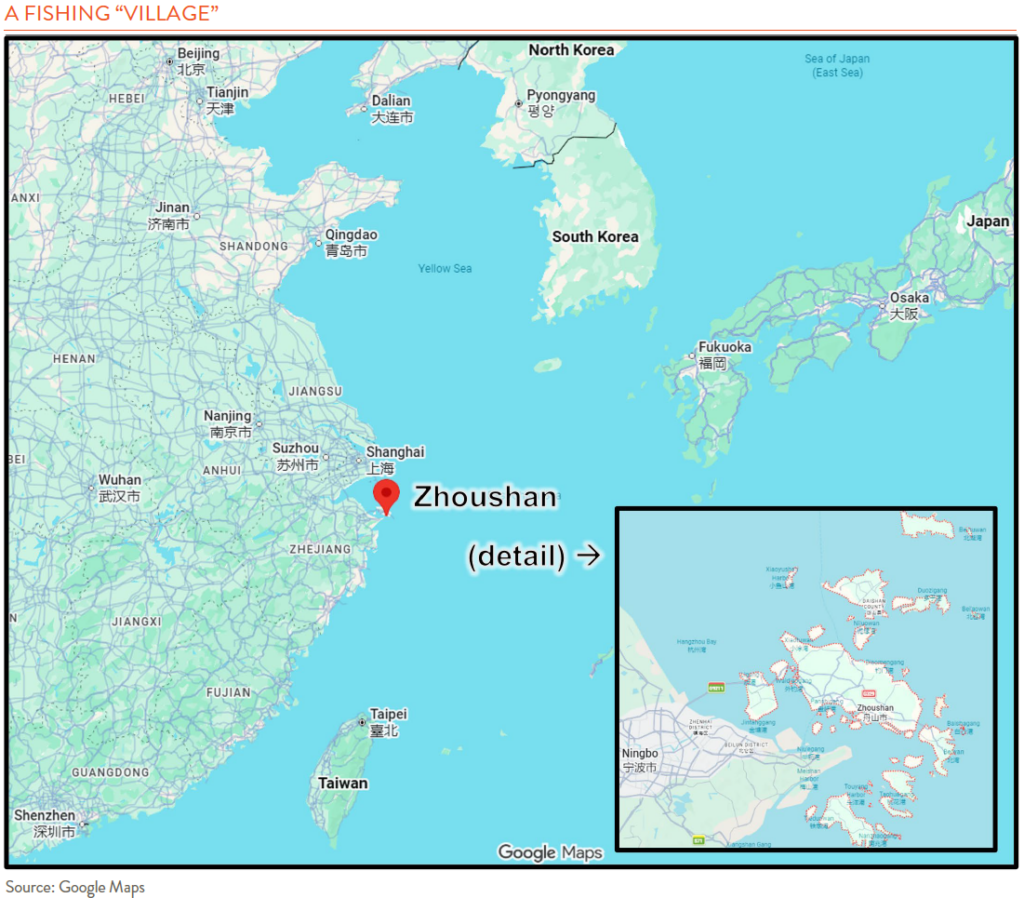
My wife and I live part of the year in Zhoushan, one of the largest fishing villages in China, about three hours south of Shanghai (see map). The population is about one million, large by U.S. standards but small by Chinese. China has over 140 cities with a population of over one million. The economy is based on fishing, tourism, and shipping.
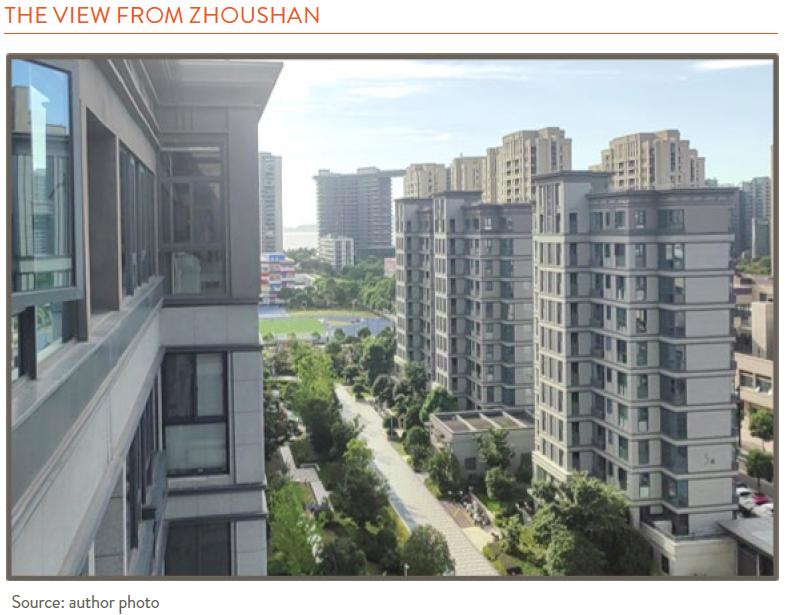
Our apartment is in a twelve-tower complex housing probably fifteen-hundred people. Outside the north and south gates are shops, restaurants, and most everything you would need on a daily basis—even a badminton racket-stringing shop! Whatever is not available nearby can be ordered online with delivery handled by an army of moped delivery drivers.
Our apartment is a two bedroom, two bath unit of about 1,400 square feet, with all the amenities of an apartment in the U.S. It is small by U.S. standards but about standard for middle class in Zhoushan. We do not own a car or a moped. Public buses (all electric) run frequently, the Chinese equivalent of Uber is everywhere, and when traveling around China, the Gao Tie high speed rail is super convenient. China has thirty-thousand miles of high-speed rail, with trains running up to two hundred miles per hour.
Okay, that’s the positive side of the story. There are downsides to Zhoushan (and China) today. The first is that the domestic economy is weak. This is why Chairman Xi is angling for more exports to the U.S. The weak economy is primarily due to the housing boom/bust. China experienced a massive housing boom starting around 2000. Part of this was the need to house the growing middle class. But part of the boom was pure speculation. As apartment prices rose, investors bought apartments both to live in and for speculation. It is estimated that the average urban Chinese has 70-80% of their net worth tied up in apartments. The bubble burst in 2020 and, on average, apartment prices across the country are down 50%. Our apartment soared in value initially only to fall subsequently. Today, it is probably worth only what we paid for it or slightly less. Zhoushan has its share of half completed apartment complexes referred to as ‘rotten tails.’
To offset weak consumer spending the federal government could increase social spending on healthcare and pensions, but Chairman Xi worries about the slippery slope of a welfare state. China must not grow soft, he says, but instead learn to ‘eat bitterness’ as past generations did.
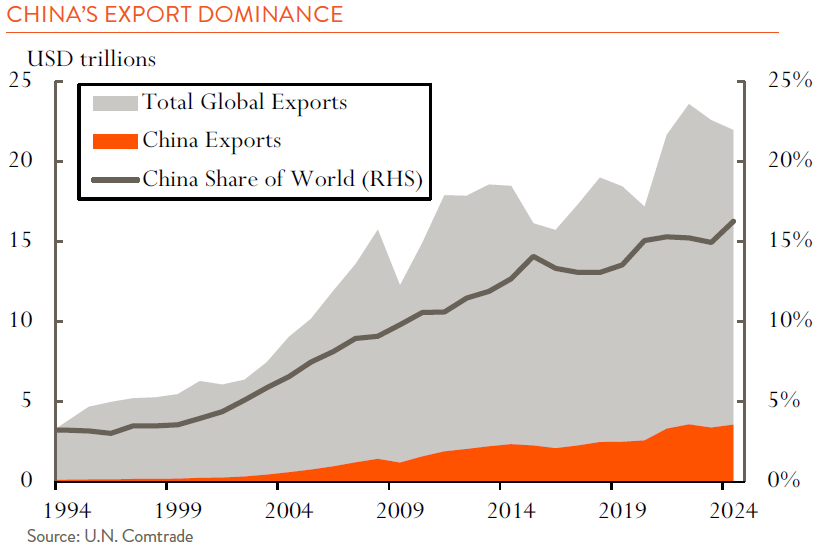
The country ran an unheard of $1 trillion trade surplus last year. The rest of the world is getting tired and angry at seeing Chinese goods hollow out its local industries. How much longer China can grow through exports remains to be seen.
The weak consumer sector is affecting both Chinese and foreign firms. Nike, Starbucks, and U.S. car companies are all suffering in China and they, along with McDonalds, are reassessing their strategies. Chinese consumers are no longer as enamored with U.S. products. Luckin Coffee has far more stores and cheaper prices than Starbucks. Home grown apparel & shoe companies, Li Ning and Anta, are cutting into sales at Nike.
One bright spot in Zhoushan is the restaurant sector. It is estimated that eating out in China is only about 40% more expensive than buying food and cooking at home. In the U.S., the difference might be three to four times. KFC is thriving and is still a fast-food favorite among Chinese, although interestingly it is dark meat, not white, that is the chicken part of choice for Chinese consumers.
