
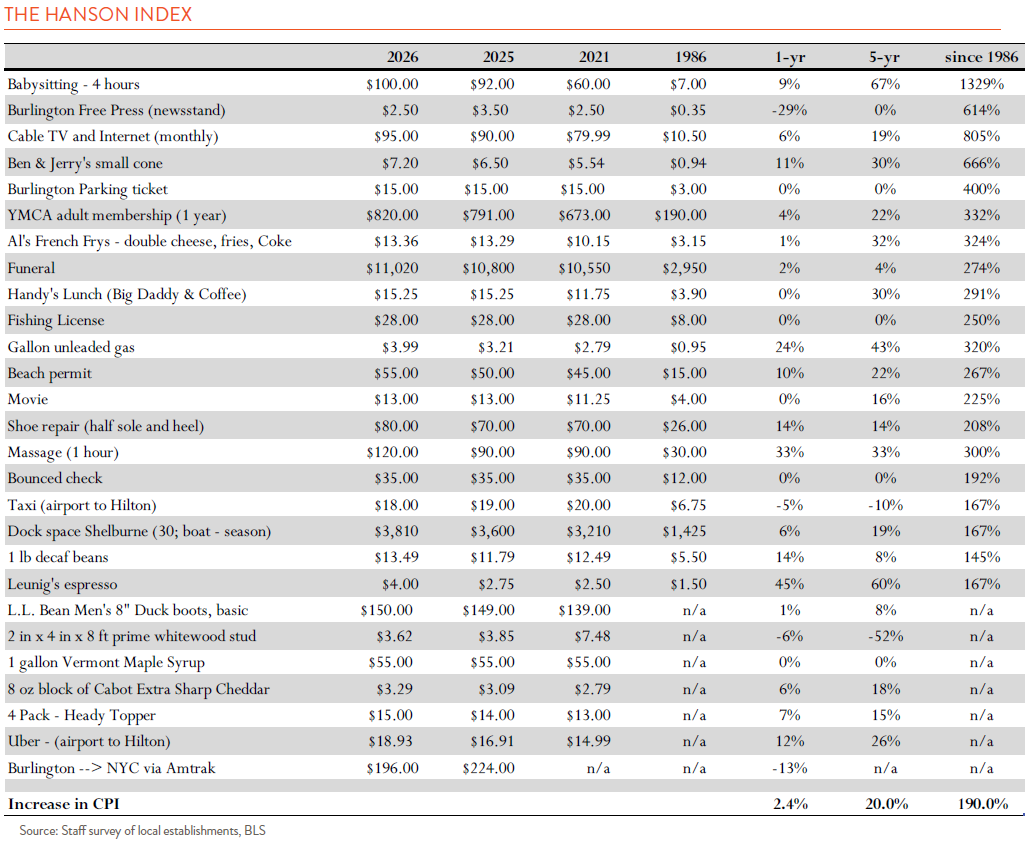
…and the winner is, childcare! More on that later. For now, welcome to the 40th year of the Hanson Index, our annual look at the cost of everyday life in Burlington. What began as a simple snapshot of local prices has become a record of how inflation reshapes our financial reality.
Let’s start with a local family where the parents are looking to spend a Friday night out. According to the Index (bottom , that costs around $170 today: babysitting, dinner for two at Al’s French Frys, two small cones from Ben & Jerry’s, and two movie tickets (see chart below). If that doesn’t give you sticker shock—and we are talking Al’s here, not Hen of the Wood!—consider the price of a date night has risen by nearly 50% since the pandemic. The culprit is babysitting, which accounts for most of the cost and the increase. In fact, as the Hanson Index turns 40, it is babysitting that claims the bragging rights, surpassing all other items we’ve tracked since inception and growing at an annualized rate of around 6.9% versus the Consumer Price Index’s (CPI) 2.7%.

The Hanson Index is by no means scientific, but the rise in babysitting costs mirrors the childcare component of the official CPI data, which has grown enormously, especially since the pandemic. Many centers had to close, and while the issue is much more complex, some of it is simply supply and demand. In Vermont, the numbers are bleak, with the cost for just one kid in daycare around $19,000, or 22% of median household income, according to the Census Bureau’s 2024 data.
While babysitting serves as a proxy for childcare in the Index, some of the costliest, fastest growing, and most essential parts of household spending are conspicuously absent. Notably, housing, healthcare, and education, and each of these areas has put the squeeze on families, outpacing CPI over the past 40 years. This is, sadly, well-worn and hard felt territory, and the sum of it is, it’s becoming harder for many to just get by. Real (i.e. inflation-adjusted) household income in the U.S. has barely budged, on net, since 2019. We would pile on with the recent rise in gas prices, but this has taken too dismal a turn as it is.
Instead, let’s look at what’s been most immune to price hikes: coffee. And mercifully so—coffee has been one of the most critical inputs to productive human capital here at Hanson and Doremus. Really, though, it is impressive that an espresso shot from Leunig’s managed to ignore rising costs for so many years, and even with the $1.25 bump this year, it wins the prize for lowest inflation over the last 40 years.
Finally, when inflation gets us down, it’s worth reminding ourselves of the power of market forces and the magic of compounding returns. Since the start of the Hanson Index, a portfolio of 60% global stocks and 40% U.S. bonds has produced a total (i.e. with dividends and interest reinvested) annualized return of 8.3%. That far outpaces the CPI and even some of the largest and fastest growing components of it (chart below). Not everything moves in unison, and every decade has its own story, but investing has thus far proven to be an effective strategy to keep up with the cost of living.

Endnotes
ChildCare Aware, “Child Care in America: 2024 Price & Supply”, https://www.childcareaware.org/price-landscape24/#PriceofCare and Census Bureau, “QuickFacts Vermont” https://www.census.gov/quickfacts/fact/table/VT/INC110224
The Census Bureau, American Community Survey Data
