Quarterly earnings calls give company executives a chance to discuss results, outline plans, and answer analysts’ questions. They sometimes move stock prices. Rarely do they inspire listeners to buy a book about nineteenth-century finance.

Source: Penguin Random House
And yet, Microsoft CEO Satya Nadella did just that on the company’s fiscal fourth-quarter call in July. Asked about the risk of excess investment in AI infrastructure, Nadella said the management team was reading 1873: The Rothschilds, the First Great Depression, and the Making of the Modern World by Liaquat Ahamed. His key takeaway: “you’ve got to run an efficient railroad.” The comments sparked articles, social media chatter, and plenty of hot takes—and put the book on the Hanson + Doremus book club’s reading list.
Ahamed’s first book, the Pulitzer Prize-winning Lords of Finance, examined the role of central bankers in the Great Depression that began in 1929. His new book, published in June, delves further back to the turbulent time of 1873 and what he describes as the first truly global financial crisis, spreading from the major western financial capitals to Latin America, North Africa, and the Middle East. The Rothschild banking family helps connect the many interwoven threads of the story, but the book’s lessons reach well beyond one family or one century.
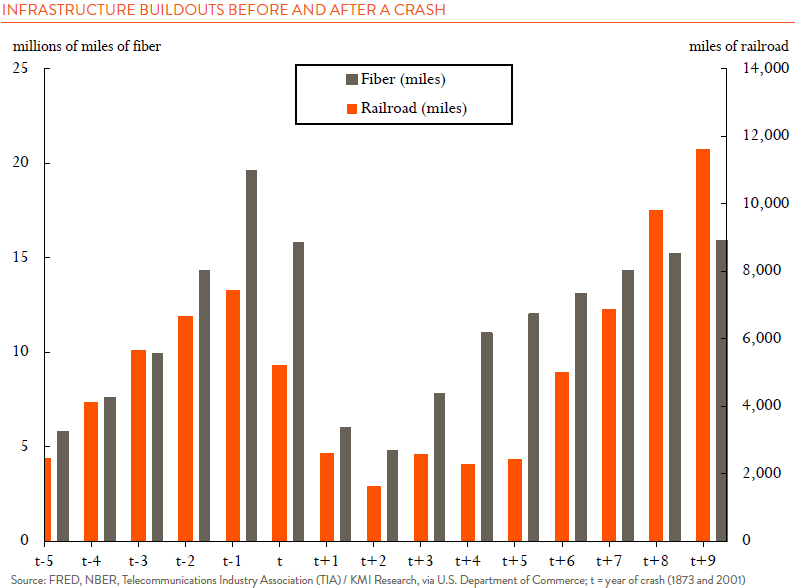
So why would a book about a Victorian-era financial crash interest the CEO of Microsoft? The 1873 crash was driven by a speculative mania in railroad investment, financed heavily by debt. That already sounds like a cautionary tale for AI investment today, and Ahamed makes the parallel explicit near the outset. He translates the roughly $500 million flowing annually into U.S. railroad bonds in the early 1870s into a modern equivalent of about $600 billion. At the time of publication, that roughly matched projected spending by major technology firms on AI in 2026. The comparison helps explain why the book caught Silicon Valley’s attention.
Ahamed isn’t the first one to examine the common features of speculative bubbles. In his 1999 book, Devil Take the Hindmost: A History of Financial Speculation, Edward Chancellor describes a familiar pattern: “speculative manias commonly occur at the inception of a new industry or technology when people overestimate the potential gains, and too much capital is attracted to new ventures.” Weak regulatory oversight, excessive borrowing, and investment flowing into even the worst companies in the speculative sector can follow. The observations drawn by both authors leave the reader with an uncomfortable sense of déjà vu.
Despite the similarities, there are differences between our current environment and the world of the 1870s. Back then, railroads were expanding across the literal Wild West, aided by government land grants and subsidies but subject to limited oversight. The regulatory environment was equally lax in finance, and fraudulent railroad companies were able to raise large sums from investors with few protections. While fraudulent AI companies may exist today, the leading technology firms attracting the most capital are behemoths with established businesses and substantial earnings behind their investments. That gives them a stronger foundation, although it offers no guarantee against overbuilding or disappointing shareholders.
The real common factor from 1873 to today is human behavior. Investors like to think “this time is different,” and that new technology will be adopted more quickly and generate exceptional returns sooner than anything that came before. While the speed of adoption is accelerating, humans are still prone to all the usual cognitive traps. Groupthink can still cause prices to overshoot and leave little room for disappointment. Fear of missing out and overconfidence continue to draw still more investors into the excitement.
Unfortunately, even calling a bubble as it’s occurring is not necessarily enough to protect us. Ahamed cites contemporary observers in the 1870s who identified speculative excess in Vienna’s real estate, New York’s railroads, and London’s foreign securities. Recognizing a bubble, it seems, offers little help in predicting when it will burst, and selling too early can mean sitting out on years of gains.
Recent markets illustrate the cost of staying on the sidelines. From 2023 through 2025, the Magnificent Seven (“Mag 7” – Microsoft, Nvidia, Alphabet, Amazon, Meta, Tesla, and Apple) generated more than half of the S&P 500’s total return. The cumulative return for the index over that period was around 88%. It would have been 40% without the Mag 7. Nvidia alone contributed 15.5% to the index’s gain in 2025, with Alphabet contributing another 13.5%.
But the aftermath of 1873 offers another lesson. The crash did not end the railroad age. Indeed, construction continued and the network expanded—investment in railroads was even higher in the 1880s than in the 1870s! And railroads transformed commerce. The technology’s promise was legitimate, but financial market assumptions far outpaced what the businesses could actually earn. Both things can be true: investment can help build a more productive economy and still disappoint the people who financed it.
The Rothschilds’ relative caution during the boom offers a useful starting point. For investors today, skepticism and diversification remain sensible defenses. We can question ambitious forecasts, pay attention to valuations, and avoid putting too much of our wealth behind a single outcome. That may mean accepting lower returns if the boom continues, but it can make any eventual setbacks easier to endure.
Back to Nadella: Microsoft’s challenge today is to turn all that computing capacity into services customers will pay for, at a profit. “Running an efficient railroad” is a good first step. Our challenge as investors is to determine how much to pay for a share of those profits. AI technology may be new, but the discipline required to invest in it is as old as the railroads.