
The Fed’s mandate sounds straightforward enough: keep inflation low and stable and support a strong job market. Doing so is another matter. Between the summer of 2016 and the end of 2022, I worked in the New York Fed’s Markets Group—the team responsible for implementing monetary policy decisions and monitoring financial markets. My time there gave me an appreciation for the difficulty of the job and the judgment and character of the people called upon to do it. As Jerome Powell exits the Fed, I want to share some reflections on the important role of Fed Chair and a public servant I came to admire.
Financial market participants love a good doomsday moniker. Over the years, there have been all kinds: the “SaaS-pocalypse” earlier this year, the “Repo-calypse” of 2019. Don’t worry about what they mean. If your job is in financial markets, especially if your job is to monitor developments and brief policymakers, days when things are imploding are always big days. One I’ll never forget is the “Vol-pocalypse” of 2018. It was also the day I got a phone call from Jerome Powell.
Monday, February 5th, 2018, was Powell’s first day as Chair of the Federal Reserve. Coincidentally, it was also my first day staffing the policy briefing “Desk” in the Markets Group. Financial markets didn’t care about any of that. Stocks were tumbling, and massive “short volatility” bets that depended on relatively calm markets were blowing up.
At around 4 p.m., the phone rang.
“Markets, this is Mark.”
“We have Chair Powell on the line…”
I have no idea what I said next, but that call was my first encounter with Jerome Powell. In the years that followed, I watched every one of his press conferences, through the pandemic, the inflation surge of 2022, the banking crisis in 2023, tariffs in 2025, and every “apocalypse” mentioned above. This is a personal history of sorts, so I won’t hide my bias: Powell was the consummate public servant. He had a strong sense of duty grounded in the Fed’s mandate, an appreciation of what he didn’t know, and little interest in making himself the center of attention.
That does not mean he got everything right. Getting it right matters immensely, but so does the character with which a Fed Chair faces uncertainty, because the job requires acting in a world that does not offer easy answers. The questions and conditions change from one crisis (or apocalypse) to the next, and the playbook has to change with them. Financial markets and the economy don’t explain themselves with neat “fundamental” drivers, as badly as we’d like to account for every zig and zag. Maybe that sounds obvious, but it is easy to overlook how much certainty we demand from our central bankers. The pressure to get it right is enormous.
Inside the Fed, the drive to make sense of things can be intense. A Fed Governor once asked me to quantify the extent to which investors’ efforts to manage the risk in mortgage-backed securities might be exacerbating a sharp increase in Treasury yields. He interrupted my nuanced (and I’m sure highly competent) explanation of “convexity hedging,” demanding to know exactly how many basis points—hundredths of a percentage point!—the 10-year Treasury yield had moved as a result. What he wanted was a degree of precision no evidence could support.
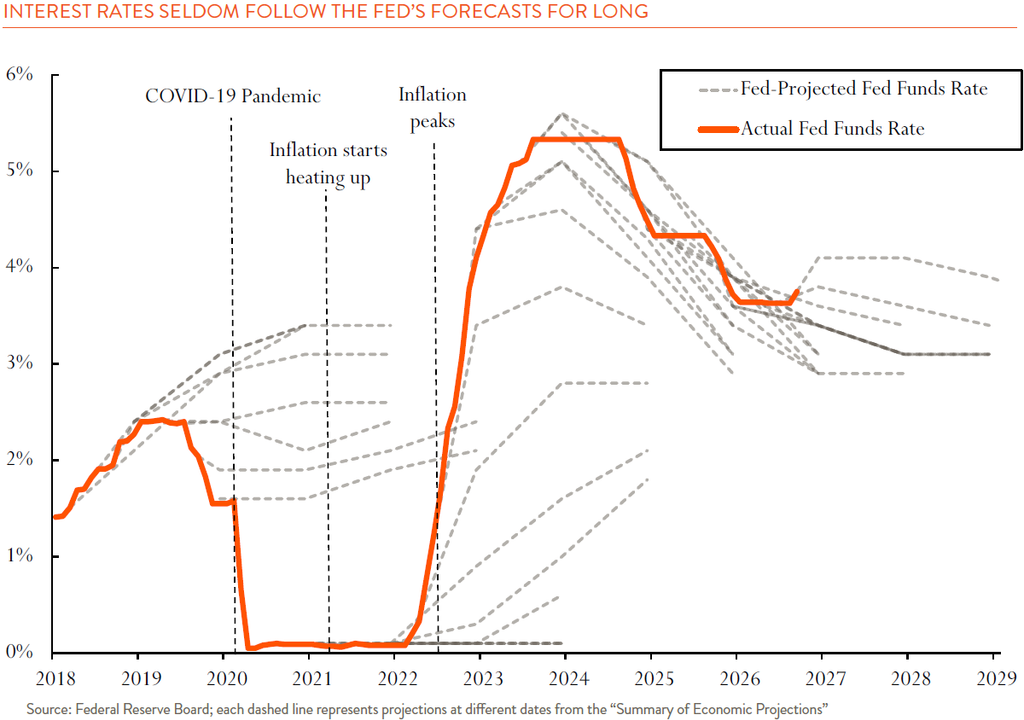
Of course he wanted a precise and reliable answer. But those are hard to come by—even the basic guideposts that help policymakers set interest rates leave plenty of room for judgment. Higher rates generally make borrowing more expensive and slow spending; lower rates encourage it. The so-called “neutral rate” is the level that neither heats up nor cools down the economy. Central bankers use it to judge whether they have their foot on the gas or the brakes, yet the neutral rate itself cannot be observed directly. As Powell often put it, “we know it by its works.”

Measures of financial conditions also help inform officials how easy it is to access credit, but they combine a whole mess of inputs, and someone has to decide how to weight them. Economic indicators are far from perfect, too. Employment data rely on household surveys, many conducted—gasp—by phone. Even the all-important inflation number is measured several ways, and different components might matter more at different times. Meanwhile, the effects of interest rate decisions can take a long time to work their way through the economy, arriving with those famous “long and variable lags.” How’s all that for certainty?
Still, the job requires making decisions, explaining them, and accepting responsibility for their consequences. Even as the Fed was late to recognize how persistent post-pandemic inflation would be, Powell was transparent in laying out how he saw things, what might change his mind, and acknowledging what he didn’t know. Once the incoming inflation data convinced him, the Fed acted firmly. All along, Powell was frank about the pain both inflation and higher interest rates would cause households.
On top of economic uncertainty and monetary policy decisions, Powell had to weather an unusually contentious political environment. Twice a year, the Fed Chair testifies before Congress. Lawmakers on both sides often use the occasion to grandstand, asking rhetorical questions designed to produce soundbites that play well with their base. Powell refused to take the bait. Even when a question struck me as absurd, he took it at face value and answered thoughtfully.
That made it all the more striking when Powell did speak up. Earlier this year, political pressure escalated to threatened criminal charges. Powell defended the Fed’s ability to make decisions on economic grounds, keeping the focus on the office, not the officeholder. He let the many personal attacks pass but drew the line at threats to the institution’s independence.
And that independence matters well beyond Powell’s tenure. It allows the new Chair, Kevin Warsh, and those who follow him to make difficult decisions with imperfect information, free from political coercion. The strength of our institutions depends on the integrity of the public servants who lead them. To me, Powell was one of the best.
I never spoke to Jerome Powell again, but I listened to him for eight years. If Kevin Warsh calls the Desk during the next apocalypse, someone else will pick up. But we’ll all be listening.
Good luck, Chair Warsh.
So long, and thank you, Chair Powell.
