
The Strait of Hormuz closure at the end of February led to the largest disruption of global oil supply in history, with some observers predicting that crude oil prices would skyrocket from $60 per barrel to above $200 if the conflict persisted. Well, the conflict persists and yet the direst predictions of an oil crisis worse than the 1970s have yet to be realized.
To understand why, bear with us as we go back to Econ 101. Recall, price depends on supply and demand. If demand for a certain quantity of oil is inelastic (i.e. fixed, inflexible) due to the global economy’s reliance on it, any change in supply is going to cause prices to steeply increase. This understanding underpinned many analysts’ models for global oil demand. So, when it was estimated that 20% of the world’s oil supply would stop flowing, prices were projected to skyrocket. But there were factors on both the supply and demand side of the equation that prevented the worst from happening.
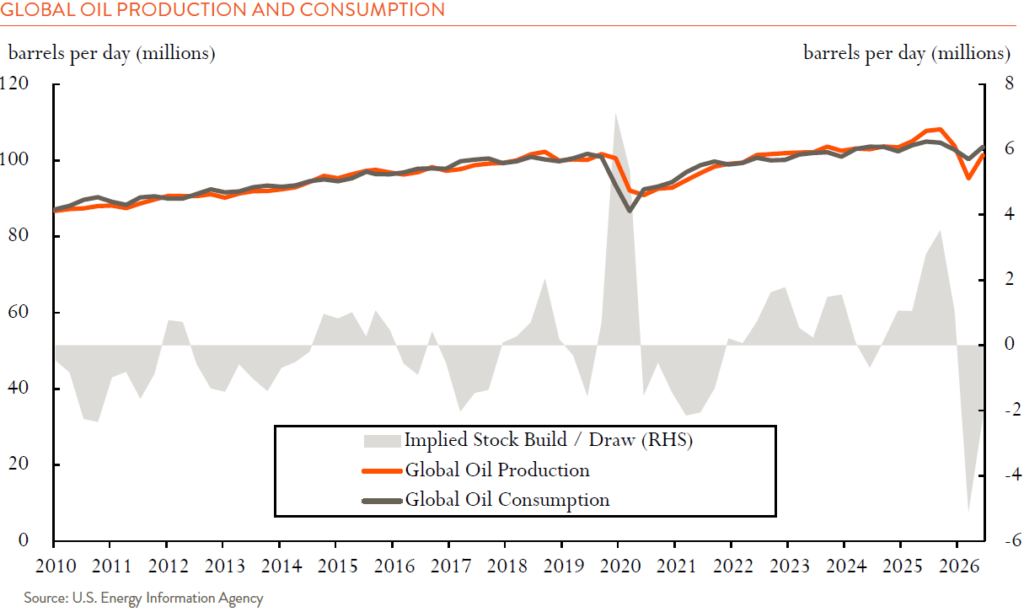
Let’s start with the supply side. Simply put, oil supply was less scarce than originally estimated. After the oil price spike caused by the 2022 Ukraine-Russia conflict, many countries made strategic moves to bolster their reserves. As a result, the world was, in fact, oversupplied heading into the war with Iran this year. Thus, when the Hormuz tap stopped flowing, governments were ready and able to deploy reserves (see chart for the tight link between production and consumption as well as the estimated stock builds and draws).
But there was also another source of supply: the black market for oil. While we can’t know exact volumes, sanctioned countries such as Russia, Venezuela, Syria, and others, utilize shadow fleets of tankers to obscure a thriving supply chain that isn’t on the books. To alleviate the worst impact of the supply shock, countries eased restrictions on this illegal supply. Additionally, U.S. production surged and alternate shipping routes further eased the pressure on prices.
On the demand side, countries dependent on Gulf oil imports adapted, demonstrating that demand was much more elastic (i.e. flexible) than previously projected. To curb consumption, Bangladesh cut working hours; Thailand urged people to work from home to reduce non-essential demand; and the Philippine government issued tax incentives for installation of residential solar panels and battery storage.
China also played a large role. The country imported 15% of its oil from the Gulf, and managed to reduce these imports by 25%, basically overnight, according to Bloomberg, all seemingly without any visible disruption. To be sure, we don’t have great visibility into China’s economy, but The Wall Street Journal reports that China cut back on petrochemical inputs, substituted with other fossil fuels like coal, and encouraged increased usage of less oil-dependent activities, such as electric rail travel over flying. China, reportedly, utilized its own reserves and leaned heavily into the black markets to find additional oil supply.
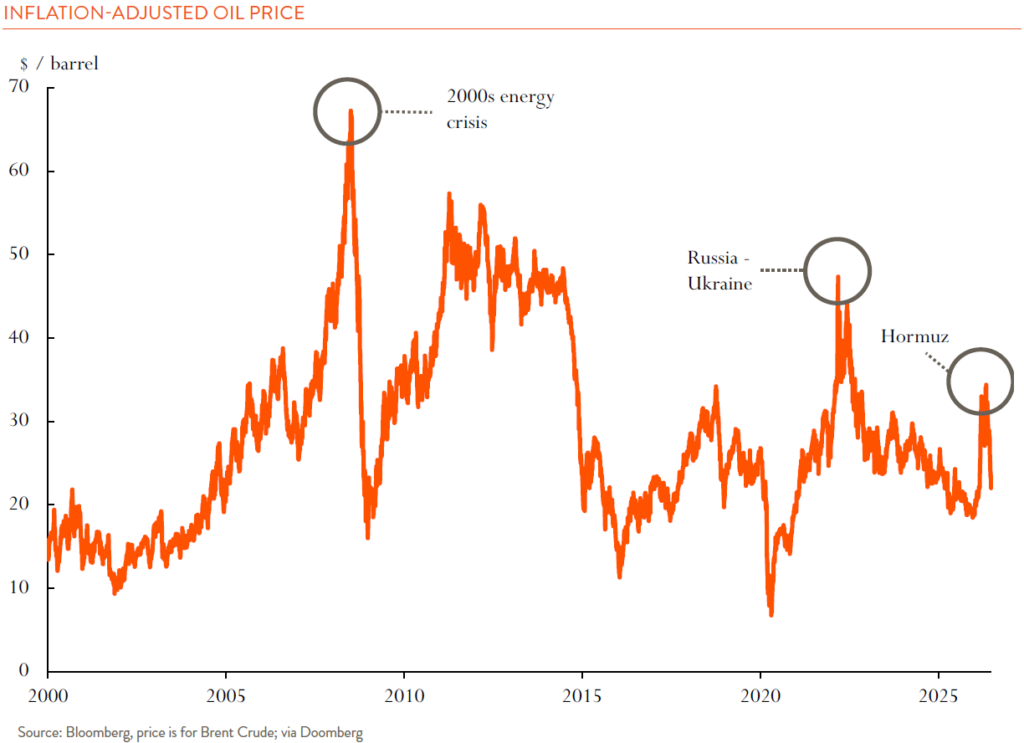
Bigger picture, conditioned by disruptive supply shocks from 1973 through 2022, the world’s demand curve has become more elastic. Individuals and governments have built more redundancy into both the energy mix and supply chains and substitutes for fossil fuels are also more prevalent today in electric-powered transportation and renewables. So while the world consumes more fossil fuels than ever before, it is also less dependent on them. The chart below illustrates this: inflation-adjusted oil prices since the start of the century have become less sensitive to shocks over time. The Hormuz “crisis to end all crises” is one of the smaller blips on the chart. Russia’s invasion of Ukraine did more to the price of oil than closing Hormuz.
While thus far the globe has been able to cope with the biggest oil supply shock in history, it will also likely have knock-on effects. First, oil and gas supply chains are bound for a shakeup as the crisis diverts transportation routes and new networks are formed. Second, players in the oil industry will need to bake supply shock risk into their cost of doing business, because if 20% of the world’s oil can be disrupted once, why couldn’t it happen again? That probably means, all else equal, slightly higher gas prices moving forward. Finally, this crisis is likely to further reinforce the shift toward reducing oil dependence. For example, innovations could make green technologies more accessible and accelerate demand for alternative energy sources—and continue to make that global demand curve more elastic.
